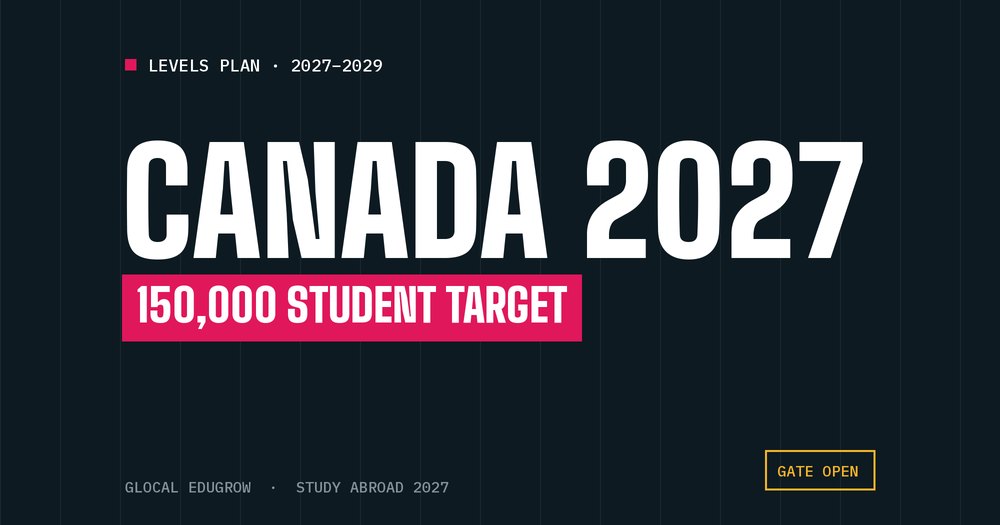
Canada now has a number for new international students: 150,000 a year. Immigration, Refugees and Citizenship Canada (IRCC) set it in the 2027–2029 Immigration Levels Plan, published on 5 November 2026 and followed by the detailed category tables. It's the first time the plan has given a clear multi-year target for students, so if Canada is on your 2027 list, start here.
The Canada study permit cap 2027: what the plan says
| 2027 | 2028 | 2029 | |
|---|---|---|---|
| New international students | 150,000 | 150,000 | 150,000 |
| New temporary workers | 220,000 | 220,000 | 220,000 |
| All new temporary residents | 370,000 | 370,000 | 370,000 |
The overall temporary resident target sits in a range of 355,000 to 385,000 a year. IRCC says the plan backs the government's commitment to reduce Canada's temporary resident population. Only the 2027 figures are firm targets. The 2028 and 2029 numbers are notional until they're confirmed next year.
What counts towards the 150,000
- Included: new study permits for programmes of six months or more at a provincial or territorial Designated Learning Institution (DLI).
- Not counted as new arrivals: Post-Graduation Work Permits (PGWPs). IRCC sees a PGWP as an extension or change of status for someone already in Canada. So PGWPs don't eat into the worker or student targets.
What it means if you're applying from India
A fixed target, plus a stated aim of cutting temporary resident numbers, means competition for study permits will probably stay tough. Here's how we usually suggest you respond:
- Apply early. Build your shortlist now for September 2027, and have your offer and documents ready well before peak season. Our 2027 intakes and deadlines guide has the dates.
- Pick your institution with care. Only programmes at DLIs lead to a study permit. If you want to work after graduating, check that both the programme and the institution are PGWP-eligible. Our guide to PGWP rules shows you what to look for.
- Leave no gaps in your finances. Clear, verifiable proof of funds and a study plan that makes sense sit at the heart of a strong application.
- Sort your English score early. A strong IELTS, PTE or CELPIP result opens up more institutions. Take a look at our IELTS coaching.
- Keep a backup country. Plenty of students apply to Canada alongside the UK, Ireland, Germany or Australia. That way one decision doesn't decide their whole year.
Official sources
- IRCC: Building a stronger Canada through a well-managed, predictable immigration system (5 November 2026)
- IRCC: Supplementary information for the 2027–2029 Immigration Levels Plan
Our Canada page lets you compare Canadian universities, costs and intakes. Or book a free counselling session and we'll help you put together a 2027 plan with a backup.
Frequently asked questions
How many international students will Canada accept in 2027?
Canada's 2027–2029 Immigration Levels Plan targets 150,000 new international student arrivals a year in 2027, 2028 and 2029. The 2028 and 2029 figures are notional until confirmed.
Does the cap include Post-Graduation Work Permits?
No. IRCC treats a PGWP as an extension or change of status for someone already in Canada, so PGWPs are not counted as new arrivals in the plan's targets.
Is it still worth applying to Canada for 2027?
Yes, for the right profile. The target still allows 150,000 new students a year, but competition is likely to stay strong, so apply early, choose eligible institutions and keep a backup country.
Which programmes count towards the student target?
New study permits for programmes of six months or more at a provincial or territorial Designated Learning Institution.