Judge Dennis Saylor IV of the US District Court for the District of Massachusetts ruled on 16 November 2026 that the Department of Homeland Security's (DHS) final rule ending Duration of Status (D/S) for international students was "arbitrary and capricious" under the Administrative Procedure Act. He set the whole rule aside.
With the duration of status rule vacated, very little changes for you. If you're an Indian student in the US on an F-1 visa, or you're planning to start in 2027, the rules you already know stay exactly where they are. That's good news.
The short version
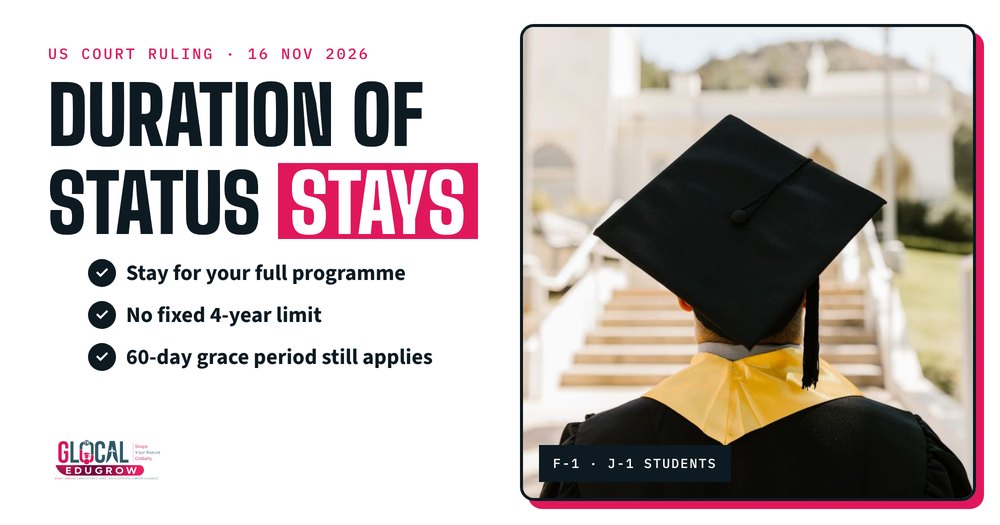
- Your stay runs for the full length of your programme. No fixed four-year limit applies, and your I-94 still shows "D/S".
- Transferring or starting another programme doesn't automatically mean an extension. Your Designated School Official (DSO) handles the SEVIS transfer or new I-20, the same way as before.
- You still get the 60-day grace period. The 30-day figure belonged to the blocked D/S rule, and it never took effect.
What is Duration of Status?
Since 1978, most F-1 students, J-1 exchange visitors and I (foreign media) visa holders have been admitted to the US for "duration of status", not until a fixed date. So you can stay as long as you:
- are enrolled full time in an approved programme,
- hold a valid Form I-20 (or DS-2019 for J-1), and
- follow your visa rules, including approved work such as CPT or OPT.
When you land, CBP writes "D/S" on your I-94 instead of a date.
What the blocked rule would have done
DHS published the final rule on 17 July 2026, with a start date of 15 September 2026. Had it gone ahead, it would have:
- Ended D/S, admitting students only until the programme end date on their I-20, capped at four years.
- Forced an extension application to USCIS (Form I-539, with a fee and biometrics) for anyone who needed longer, say for a longer PhD or a thesis that ran late.
- Shortened the F-1 grace period from 60 days to 30 days after you finish a programme or OPT.
- Restricted academic mobility, with new limits on transferring and changing programmes.
Timeline: how we got here
| Date | What happened |
|---|---|
| August 2025 | DHS proposes ending duration of status |
| 17 July 2026 | DHS publishes the final rule |
| September 2026 | The court blocks the rule before its 15 September start date |
| 16 November 2026 | The court vacates (sets aside) the whole rule |
Why the judge threw the rule out
The Administrative Procedure Act (APA) says a federal agency has to reason a rule through properly before it changes the law for millions of people. Summaries of the ruling say the court found that DHS:
- didn't properly weigh the rule's costs against its benefits,
- leaned on fraud and national-security concerns that couldn't support a change this sweeping,
- ignored less burdensome alternatives, and
- didn't adequately answer important public comments.
DHS also asked to keep the rule alive while it fixed the problems. The court said no. And because the rule was vacated, it has no effect anywhere in the US, not just in Massachusetts.
What this means for you right now
1. You can stay for the full length of your programme
There's no four-year ceiling. A five-year bachelor's degree is fine. So is a long PhD, or a degree that takes one extra semester. Just stay enrolled, keep your I-20 valid and maintain status.
2. You can transfer or enrol in another programme without automatically needing an extension
Under D/S you can:
- move to another university, through a SEVIS transfer your DSO arranges, or
- begin a new programme, such as a master's after your bachelor's,
and you won't have to file for an extension of stay with USCIS. The normal rules still apply, though: tell your DSO, get a new or updated I-20 and meet the transfer deadlines.
3. The 60-day grace period still applies
Once you complete your programme, or your OPT, you still have 60 days as an F-1 student to leave the US, change status, transfer or start a new programme. If you read about 30 days, that came from the blocked rule. (J-1 exchange visitors keep their existing 30-day grace period.)
Please note: Your visa and your status are not the same thing. The F-1 visa stamp only gets you into the US. Your status (D/S) decides how long you can stay. Your visa can expire while you're in the US and you'll still be in status, but you'll need a valid visa to come back in after travelling abroad.
Could this change again?
It could. DHS has two options:
- appeal to the US Court of Appeals for the First Circuit and ask for a stay of the ruling, or
- start a new rulemaking that tries to fix what the court objected to.
Both take time. A new rule would normally appear in the Federal Register before it applies. For now, duration of status is the law, and we'll update this article if the decision is appealed.
Your checklist
- Keep your I-20 current. Look at the programme end date, and if you need more time, ask your DSO for an extension before it passes.
- Stay enrolled full time every semester, unless your DSO approves a reduced course load.
- Check your I-94 on the CBP website after each entry. It should show "D/S".
- Start transfer plans early with both your current and your new DSO.
- Count your 60 days after graduation or the end of OPT, and apply for OPT within the allowed window.
- Take your news from official sources: your international student office, ICE's Study in the States and USCIS. Not social media.
Applying for 2027?
Don't change your plans. US universities are still open to Indian students, and how long you can stay is once again tied to your programme, not a fixed cap. Put your energy into strong applications, solid proof of funds and a well-prepared visa interview. Our study in the USA page has more on universities, costs and intakes.
Got a question about US admissions, your I-20 or the F-1 visa interview? Book a free counselling session with a Glocal EduGrow counsellor, or practise common F-1 questions in the My EduGrow app.
This article is general information, not legal advice. For your own situation, speak to your DSO or a qualified immigration attorney.
Frequently asked questions
Has the duration of status rule been cancelled?
Yes. On 16 November 2026, a federal court in Massachusetts vacated DHS's final rule ending duration of status, finding it arbitrary and capricious under the Administrative Procedure Act. Duration of status stays in place unless the ruling is stayed or overturned on appeal.
Is there a four-year limit on F-1 status now?
No. The four-year cap came from the blocked rule. F-1 students are admitted for duration of status and can stay for the full length of their programme while they maintain status and keep a valid I-20.
Is the F-1 grace period 30 days or 60 days?
It is still 60 days for F-1 students after completing their programme or OPT. The 30-day figure came from the blocked rule and never took effect. J-1 exchange visitors keep their 30-day grace period.
Can I transfer universities without an extension?
Yes. Under duration of status you can transfer through a SEVIS transfer arranged by your DSO, or start a new programme with a new I-20, without filing an extension of stay with USCIS.
Does this ruling apply only in Massachusetts?
No. The court vacated the rule itself, so it has no effect anywhere in the United States.
Could DHS bring the rule back?
DHS could appeal to the First Circuit and ask for a stay, or propose a new rule that addresses the court's concerns. Any new rule would normally be published in the Federal Register first. Check with your international student office for updates.